
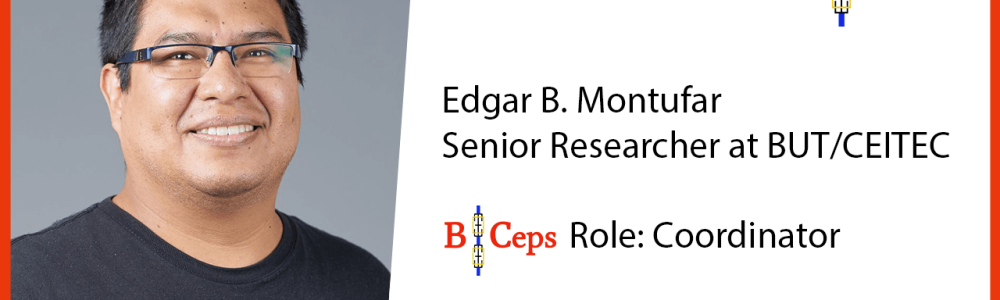
About: Edgar B. Montufar is a senior researcher at Brno University of Technology (BUT) / Central European Institute of Technology (CEITEC). He is also the coordinator of the EU-funded BiCeps project, which aims to engineer and fabricate robust muscle inspired actuators that mimic the strength, precision, speed, compliance, and reliability of natural muscle movement. Alongside BUT / CEITEC, the consortium consists of Lithoz, FunGlass / University of Trenčín, Czech Technical University in Prague (CTU) and COMTES FHT.
Q: What is your role in this project and what does your work involve?
A: My role is coordinating the multidisciplinary team that built BiCeps consortium, ensuring communication and prompt feedback to achieve the project objectives, while ensuring compliance with the tender rules. I am also WP leader at CEITEC-BUT, coordinating the task related to robocasting and powder feedstock production for multi-material additive manufacturing. I am glad to have the opportunity to lead, and learn from, a unique international team with longstanding expertise in research, development, and technology transfer, who trust me to help transform paradigms in motion generation.
Q: Where did the impetus for this project come from?
A: The project idea was born in early 2014, when the critical mass that forms the BiCeps consortium appointed me to develop a project with the potential to transform the future of additive manufacturing. It was originally a huge challenge, but immediately the possibilities became infinite thanks to the join capacities and knowledge of the team. At that point, the challenge shifted to consolidating multiple ideas into a feasible but still not created technology. The knowledge-based concept was identified at the intersection of biology and additive manufacturing.
Q: How did the consortium come together?
A: I would say that the BiCeps consortium come together ‘naturally’. The High-Performance Materials and Coatings for the Industry Research Group at CEITEC-BUT has been collaborating with each partner since a time ago, with multiple bilateral visits, join publications, and involved in competitive research projects such as CliCAM, GlaCerHub and BIODEGRADABLE. General interest and multiple capacities in additive manufacturing were then the driving force. Together the BiCeps consortium covers all available additive manufacturing technologies for metals, ceramics, polymers, composites, and multi-materials.
Q: What has been the greatest challenge and biggest success since the beginning of the project?
A: Unfortunately, I cannot disclose specific details about the technology or its development. However, at each meeting the team presents exciting results, some of which even surprise us. The outcomes are not yet optimal, and new challenges continue to arise weekly. BiCeps consortium is working daily to address them from multiple perspectives.
Q: Ideally, how would the project evolve in the next quarter?
A: Currently BiCeps project is on its first birthday. It is a healthy growing child that will move from proof of concept to applied research. Stay tuned for updates.